Overage agreements and clawback provisions explained


14 Jul 2026
— Blog
Overage agreements allow sellers to share in future increases in land value after a sale completes. Understanding trigger events, valuation mechanisms and enforcement provisions can help landowners and developers avoid costly disputes later.
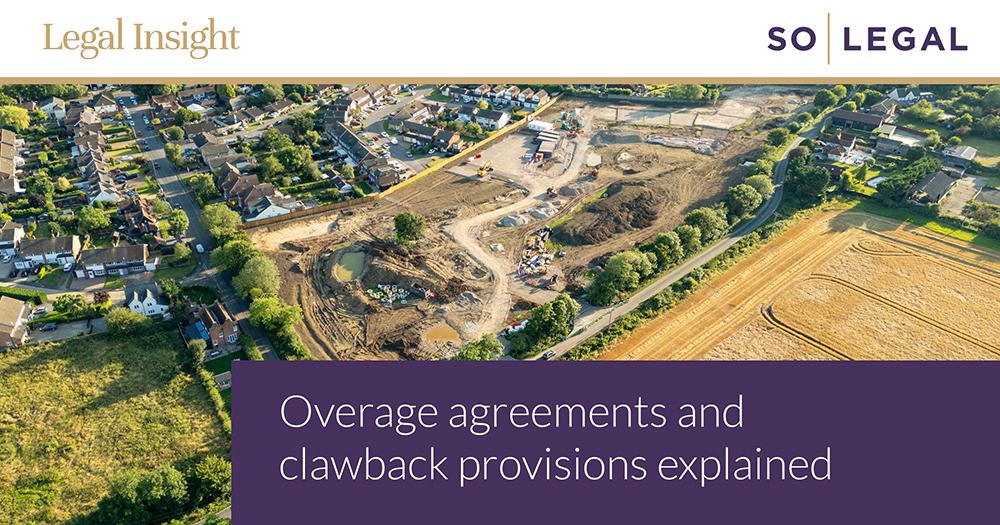
Selling land is rarely straightforward when development potential is involved.
A landowner may believe a site could one day secure planning permission and become significantly more valuable. A buyer, however, may be unwilling to pay development value today for something that may never happen.
Overage agreements are often used to bridge that gap. Rather than arguing over what the land might be worth in the future, the parties agree on a mechanism that allows the seller to share in any increase in value if certain events occur after the sale is completed.
For landowners, overage can provide protection against selling too early. For buyers and developers, it can create obligations that remain attached to a site long after the purchase price has been paid.
The challenge is ensuring the agreement is fair, commercially workable, and capable of delivering the outcome both parties intended.
Why is overage used?
In many development land transactions, the buyer and seller have different views on risk and value.
A seller may believe planning permission is likely and that the land could eventually command a much higher price. A buyer may accept that there is potential, but may be taking on significant planning, funding, and development risk.
An overage provision allows the transaction to proceed while giving the seller an opportunity to benefit if future events increase the land's value.
They are commonly used in:
- Development land sales.
- Agricultural land transactions.
- Strategic land disposals.
- Commercial property sales.
- Sites with future planning potential.
- Family land transfers.
In simple terms, the seller receives a price today while retaining an interest in future value.
Are overage agreements and clawback provisions the same thing?
While you will frequently see both terms used in land transactions, an overage agreement and a clawback provision often describe the same commercial mechanism.
In development land transactions, clawback is commonly used as another term for overage. Whether an agreement refers to overage, clawback, or an uplift clause, the core principle is usually the same: allowing a seller to receive an additional payment if the value of the land increases after completion following a specified trigger event, such as the grant of planning permission.
To ensure clarity and avoid disputes, agreements should clearly define the trigger events, valuation methods, payment mechanisms, and duration of the obligation.
What events usually trigger an overage payment?
This is often one of the most heavily negotiated parts of the agreement. The value of an overage provision is determined not just by the percentage payable but by what actually triggers the payment.
Common trigger events include:
- The grant of further planning permission.
- The implementation of planning permission.
- A change of use.
- The sale of the site.
- The sale of individual development plots.
- Development reaching a specified milestone.
- The grant of a more valuable planning consent.
The drafting matters enormously. A trigger linked to the grant of planning permission may produce a very different outcome from one linked to the implementation of that permission. Small differences in wording can have significant financial consequences years later.
How much could an overage clause be worth?
Potentially a substantial amount. A site sold today as agricultural land may become significantly more valuable if planning permission is secured for residential or commercial development.
The seller may therefore negotiate the right to receive a percentage of that increase in value.
The calculation could be based on:
- A percentage of the uplift in value.
- A percentage of sale proceeds.
- A fixed payment.
- A formula linked to planning outcomes.
- A share of development profits.
The valuation mechanism is often just as important as the percentage itself. Many disputes arise not because the parties disagree over the principle of overage, but because they disagree about how the payment should be calculated.
Why do developers often push back on overage provisions?
From a landowner's perspective, overage can appear entirely reasonable, but the buyer's position is often more complicated.
A developer may invest substantial time and money in pursuing planning permission, funding, infrastructure solutions, surveys, consultants, and professional advice. If those efforts successfully increase the site's value, an overage payment may require that part of that value be shared with the former owner.
Overage can also affect:
- Development viability.
- Funding arrangements.
- Refinancing opportunities.
- Future disposals.
- Joint venture structures.
- Site assembly projects.
For that reason, buyers will often seek to limit the scope, duration, and financial impact of any overage obligations.
How long do overage obligations last?
One of the most important commercial questions is how long the seller should remain entitled to benefit from future value. Some overage arrangements last only a few years, while others continue for decades.
The appropriate period will depend on factors such as the nature of the site, planning prospects, anticipated development timescales, and the objectives of the parties.
A longer overage period may offer greater protection for the seller, but it can also create uncertainty for future owners, developers, and lenders. Finding the right balance is often a key point of negotiation.
Why do overage agreements cause disputes?
Many overage agreements are signed long before the trigger event actually occurs. When planning permission is eventually granted or development begins, the circumstances may be very different from those originally envisaged.
Questions often arise about:
- Whether a trigger event has occurred.
- Which planning permission is relevant.
- How the payment should be calculated.
- Whether deductions should be allowed.
- Whether the overage has been deliberately avoided.
- How the agreement should be interpreted.
The larger the increase in value, the more closely the overage provisions are likely to be scrutinised. This is why careful drafting at the outset is so important.
What should landowners and developers consider before signing?
The headline percentage rarely tells the full story.
Particular attention should be paid to:
- Trigger events.
- Valuation provisions.
- The duration of the overage period.
- Any permitted deductions.
- Enforcement mechanisms.
- Anti-avoidance provisions.
- Restrictions affecting future development.
An overage clause may remain relevant for many years after a transaction completes, so understanding how it will operate in practice is just as important as understanding how it works in theory.
One aspect of overage arrangements that landowners frequently overlook is the importance of properly protecting the overage deed at the Land Registry.
An overage obligation is a personal contractual promise between the seller and the buyer, which means it doesn't automatically bind anyone the buyer later sells the land to. To prevent the obligation from being lost once the land changes hands in the future, the landowner should ensure a restriction is registered against the buyer's title. This restriction typically prevents any future sale or transfer of the land being registered unless the overage payment has been made, certified as not due, or the new owner has formally agreed to take on the obligation.
Without this step, a landowner can find that their right to receive overage payments becomes difficult, or even impossible, to enforce against a subsequent owner of the land.
Getting the balance right
Overage provisions can be an effective way of bridging the gap between what a buyer is prepared to pay today and what a seller believes the land could be worth tomorrow. However, the detail matters.
Thomas Jones, solicitor, says:
"Overage agreements are often negotiated when nobody knows exactly what a site may be worth in the future. The challenge is creating a structure that protects the seller's interest in future value without making the land unattractive to buyers, developers, or lenders. Most disputes arise because the trigger events, valuation provisions, or enforcement mechanisms were not given enough attention at the outset."
Whether you are selling land with development potential or acquiring a site subject to overage, obtaining advice early can help avoid costly disputes and unexpected liabilities later.
Get in touch if you would like advice on an overage agreement, clawback provision, or development land transaction.
Speak to our
solicitors