Option agreements explained for landowners and developers


06 Jul 2026
— Blog
Option agreements are commonly used to secure land for future development, but the terms agreed at the outset can have significant legal and financial consequences. Understanding how they work is essential for both landowners and developers.
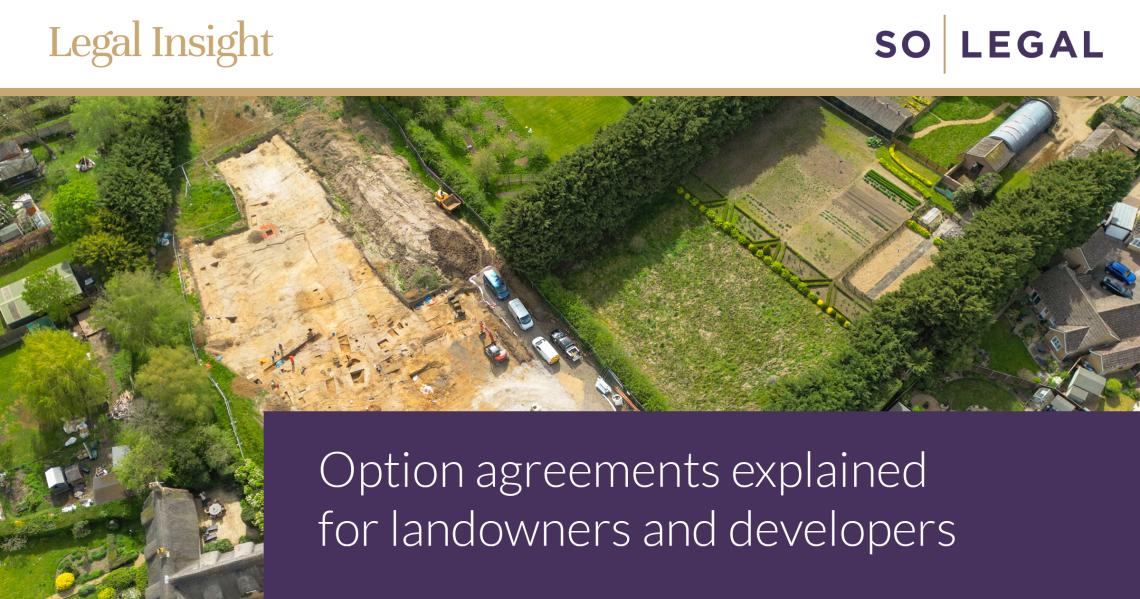
A significant number of development projects begin with an option agreement.
For developers, an option agreement can provide time to investigate a site, pursue planning prospects, and secure funding before committing to a purchase. For landowners, it can create an opportunity to realise development value which may be substantially higher than the land’s current worth.
However, option agreements are rarely as simple as they appear at first. The length of the option period, the calculation of the purchase price, the developer’s obligations, and the circumstances under which the option can be exercised can all have a major impact on the eventual outcome.
In many cases, the commercial terms negotiated at the outset will determine whether the arrangement ultimately benefits both parties.
What is an option agreement?
An option agreement gives a developer the right, but not the obligation, to purchase land within a specified period. In return, the landowner agrees that if the option is exercised, they will sell the land on the agreed terms. During the option period, a landowner will not be permitted to dispose of or charge the land (other than in specific or pre-approved circumstances).
The arrangement allows the developer to secure their interest in the site without immediately purchasing it. During the option period, the developer can investigate the land, commission reports, explore planning opportunities, and assess whether a viable development can be delivered.
If the site proves unsuitable or planning permission cannot be secured, the developer will often be able to walk away without buying the land.
Why are option agreements used in property development?
Development land often carries a degree of uncertainty. A site may have development potential, but until planning permission is obtained, neither party can be certain what can be built, how valuable the land may become, or whether the project is financially viable.
An option agreement allows that uncertainty to be explored before a purchase takes place.
Developers commonly use option agreements to:
- Secure their interest in potentially strategic land.
- Pursue planning permission.
- Carry out surveys and investigations.
- Assess development viability.
- Reduce upfront acquisition costs.
- Explore funding options.
For landowners, the arrangement can provide access to development expertise and planning resources which they may not otherwise have.
How is the purchase price determined?
One of the most important aspects of any option agreement is the mechanism for calculating the purchase price.
Many landowners focus on the possibility of obtaining planning permission but pay less attention to how the eventual value of the land will be assessed.
Common approaches include:
- A fixed purchase price.
- Open market value.
- Open market value less an agreed discount.
- Formula-based calculations linked to planning outcomes.
- Independent valuation mechanisms.
The difference between these approaches can be substantial, particularly when planning permission significantly increases the site’s value. A pricing mechanism that appears reasonable at the outset may produce a very different result years later when the option is exercised.
How long should an option period last?
The answer depends on the site’s nature and the planning strategy being pursued. Developers will often seek the longest possible option period to maximise flexibility and reduce risk, while landowners usually want the shortest possible period to avoid their land being tied up unnecessarily.
Factors which may influence the length of the option period include:
- The complexity of the planning process.
- The size of the site.
- Environmental considerations.
- Infrastructure requirements.
- Local authority timescales.
- Market conditions.
An option period which is too short may not give the developer enough time to pursue planning successfully. One which is too long may restrict the landowner’s ability to pursue alternative opportunities, as the land is effectively frozen during that time.
In all instances, an option agreement will have a longstop date. This is a date on which, no matter what is outstanding, the option will come to an end. If planning permission is outstanding and the long stop date passes, the agreement will come to an end. This is key as it keeps the landowner’s land from being frozen indefinitely. If the developer requires an extension, they will have to seek to vary the option agreement.
Can a developer walk away?
In many cases, yes. This is one of the key differences between an option agreement and a conditional contract.
An option agreement usually gives the developer a choice. If the project is no longer commercially attractive, planning permission is refused, or market conditions change, the developer may decide not to exercise the option.
Landowners should understand this risk before entering into an agreement, as a developer may spend considerable time pursuing a site but ultimately decide not to proceed.
For that reason, option fees, planning obligations, and pricing mechanisms often become important negotiation points.
What should landowners watch out for?
Many landowners will only encounter an option agreement once, whereas developers may negotiate them regularly.
Particular attention should be paid to:
- The length of the option period.
- The purchase price mechanism.
- The developer’s planning obligations.
- Access rights.
- Restrictions affecting the land.
- Rights to extend the option period.
- Termination provisions.
- Responsibility for costs.
The headline purchase price is rarely the only issue that matters. A poorly drafted agreement can restrict a landowner’s options for years and create uncertainty about the site’s future.
What should developers watch out for?
Developers face their own risks. An option agreement that lacks sufficient flexibility can undermine the project’s viability.
Developers will often want to ensure the agreement properly addresses:
- Access for surveys and investigations.
- Planning application rights.
- Site assembly requirements.
- Rights relating to adjoining land.
- Extension provisions.
- Valuation mechanisms.
- Development constraints.
The agreement should support the planning and development strategy rather than hinder it.
Option agreement, promotion agreement, or conditional contract?
Landowners and developers are often presented with several possible structures - an option agreement is only one of them.
A promotion agreement usually involves a promoter securing planning permission before marketing the land for sale on the open market.
A conditional contract generally creates an obligation to buy and sell once specified conditions have been satisfied.
Each structure has advantages and disadvantages. The most suitable approach will depend on the site, the planning prospects, the parties involved, and the commercial objectives of the transaction. Choosing the wrong structure at the outset can affect both value and flexibility later.
Common mistakes with option agreements
Many problems arise because the parties focus heavily on the prospect of development without fully considering the detail of the agreement itself.
Common mistakes include:
- Agreeing to an excessively long option period.
- Failing to scrutinise the valuation mechanism.
- Assuming planning obligations are sufficiently detailed.
- Overlooking rights to extend the option.
- Failing to consider future market conditions.
- Using precedent documents without tailoring them to the site.
The legal drafting often becomes most important when circumstances change several years after the agreement was first signed.
Protecting your position in an option agreement
Option agreements can create significant opportunities for both landowners and developers, but they should never be treated as standard form documents.
The structure of the agreement, the planning strategy, and the commercial objectives of the parties all need careful consideration before terms are agreed.
Thomas Jones, solicitor, says:
“Most disputes involving option agreements do not arise because the parties misunderstand the basic concept. They arise because insufficient attention was given to the commercial terms at the outset. Issues such as valuation, planning obligations, option periods, and extension rights can have a significant financial impact later. Spending time getting those provisions right at the beginning is almost always worthwhile.”
Whether you are a landowner considering an approach from a developer or a developer seeking to secure a site, early advice can help identify potential issues before they become expensive problems later in the transaction.
Get in touch if you would like advice on a proposed option agreement or development project.
Option agreement
solicitors