
What are the legal issues around NFTs?


10 Feb 2022
— Blog
From pictures of bored apes to an original of the first-ever tweet, sales of non-fungible tokens (NFTs) have skyrocketed over the last year - but what are the legal issues around the phenomenon?
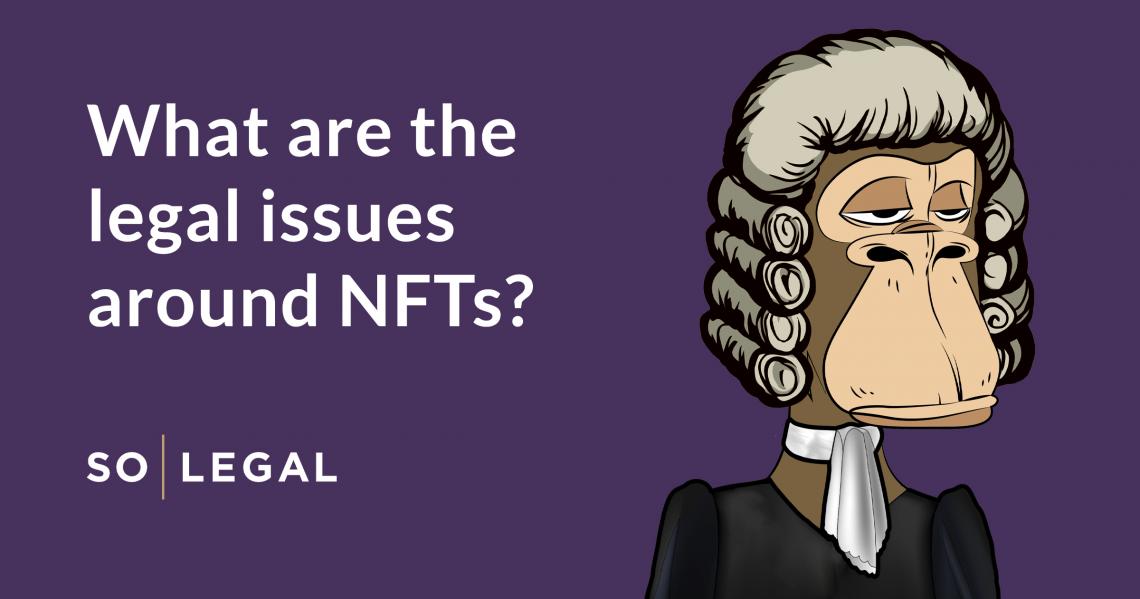
While traditional artists, musicians, galleries and venues were left struggling with Covid-related lockdowns, the non-fungible token (NFT) market exploded during the pandemic.
Over the last 12 months, artists, collectors, investors, and businesses have been left scrambling to capitalise on the potential of NFTs and fully understand how the market works.
With NFT sales now running into billions, the market faces issues that touch on many areas of law - from copyright and intellectual property rights to anti-money laundering regulations and estate planning.
This week, the subject has hit the headlines again in what is believed to be the first law enforcement action to seize an NFT asset. HM Revenue and Customs (HMRC) announced that three people had been arrested on suspicion of a £1.4m VAT fraud involving 250 fake companies.
What is an NFT?
While non-fungible token sales have been hitting the headlines, many people still don't fully understand the term or how NFT sales have sprung to prominence.
In basic terms, an NFT is a unique token attached to a digital asset - be it an image, a song, an animation or a video - for which ownership is logged and authenticated using decentralised blockchain technology, primarily cryptocurrency Ethereum.
Once the token is logged, every transaction, including future transfers and sales, is recorded on the blockchain, creating an easily accessible record of authenticity and ownership, which cannot be deleted or counterfeited.
This blockchain technology has created a market for the sale and resale of NFTs and the associated assets.
While there might be many identical pieces (e.g. a picture downloaded millions of times), the digital artist can sell one highly-valued piece as being an authentic original.
This way, the NFT market mirrors the traditional art market, where original artwork is considered to be worth substantially more than mass-produced prints.
NFTs gate-crashing the mainstream art world
Detractors have called NFTs everything from a bubble to a Ponzi scheme, but the continued growth of creating and selling digital artworks as NFTs means we cannot ignore them.
In March 2021, the digital artist Michael Joseph Winkelmann, known professionally as Beeple, sold his piece Everydays: The First 5000 Days for a staggering $69,346,250. The monumental collage was the first purely digital artwork ever offered at Christie's auction house. Until October 2020, the most Winkelmann had ever sold a print for was $100.
Of course, anyone with an internet connection can view Beeple's 'Everydays' online for free. The artwork is only ever a right-click-save away from being copied, but only the buyer can claim legal ownership of the version authenticated by Winkelmann.
Other high-profile examples of NFT sales:
- Sales of Bored Ape Yacht Club NFTs have already jumped past $1 billion, including purchases by celebrity collectors.
- Jack Dorsey, founder of Twitter, sold an NFT of the first-ever tweet for $2.9million USD.
- American rock band Kings of Leon released their eighth album as NFTs – generating over $2million in sales.
- Canadian musician Grimes sold 10 pieces depicting her digital avatar War Nymph for $6 million.
- In February 2022, a digital version of handwritten notes for the Beatles’ hit single Hey Jude has sold at auction for nearly £60,000.
Whether or not Beeple originals or jpegs of apes represent the art market's future, it is clear that the sheer scale of NFT sales is already leading to many legal and regulatory questions.
Art collector files High Court claim over NFT auction
In what is believed to be one of the first legal cases concerning NFTs, Liverpool-based art collector Amir Soleymani recently filed a High Court claim against the online marketplace Nifty Gateway.
Filed in October 2021, the claim concerns the auction terms relating to his $650,000 third-place bid for Beeple's Abundance NFT.
Bidders entered a "ranked auction" held between 30 April and 2 May 2021, with the top 100 bidders securing a numbered edition. The highest bid was made by Ethereum co-founder Taylor Gerring, who received the first edition for $1,234,567.88.
Soleymani, the third-highest bidder at auction close, was asked to pay the value of his $650,000 bid for a second edition of the Beeple work.
However, Soleymani claimed that the auction terms were unclear, and he had only bid to buy the original Abundance artwork and not a second edition that does not have the same value.
In response, Nifty Gateway reportedly froze Soleymani's other hosted NFT assets and filed arbitration proceedings in New York to seek the outstanding amount. Soleymani, in turn, instigated a counter-suit in the US, where Nifty Gateway is based, as well as his UK High Court claim.
The potential legal pitfalls
As the Soleymani case illustrates, the NFT market is still evolving, and so are the legal and regulatory issues tied to digital assets, stretching from intellectual property law to estate planning.
NFTs raise some interesting legal considerations, many of which are ambiguous or unresolved:
- Copyright - When you buy an NFT, you are not purchasing the digital work itself. Copyright relating to the artwork does not automatically transfer with the sale of the NFT. The artwork creator or the third-party seller can retain the right to copy, distribute, modify, and publicly display or perform the art.
- Privacy and data protection laws - Some data protection laws give individuals the right to erase their data. The immutable nature of blockchain technology might make this right functionally impossible to exercise. As a result, NFTs that contain personal information might violate data protection laws.
- Property law - It is important to consider which legal system governs your ability to sell or secure an NFT. The asset's location generally determines property law. However, NFTs represent a unique copy of the asset rather than the underlying asset itself.
- Money laundering - The value of NFT transactions and the widespread use of cryptocurrency inevitably raises concerns about whether these transactions are being used to circumvent anti-money laundering regulations.
- Regulatory - NFTs are non-fungible. Unlike cryptocurrencies, they cannot be traded or exchanged at equivalency. They are not securities and are not subject to securities regulations in many countries. Unregulated NFT transactions, including "wash trading", would be banned in traditional investment markets like equities because they give an artificial impression of demand for an asset.
- Taxation issues - As with cryptocurrencies, the law has been slow to catch up with NFTs and taxation - with difficulties in determining where NFTs are situated for tax purposes. While HMRC has issued a manual HMRC Cryptoassets Manual, there has been no publically published guidance on their UK tax treatment, so NFTs fall into something of a tax black hole.
- Security - Investors should be wary of the security threats posed by cyber-hacking and other online threats. An NFT and the asset it represents are typically stored separately. While the blockchain ledger is immutable, the digital artwork itself may not be as secure - for example, if hosted on the servers of a third-party website that is not secure.
- Estate and succession planning - As with other digital assets, one question that will become increasingly important over time is how the UK's legal framework can deal with NFTs on the owner's death. Leaving digitally stored assets to the next generation can lead to difficulties for executors.
Conclusions
The rapid rise of NFTs over the last year means that the law has not yet fully caught up, and investors and collectors are strongly advised to conduct rigorous due diligence when purchasing NFTs.
It remains to be seen whether the NFT market will become established as a legitimate form of collecting and trading works of art or whether it's a bubble waiting to burst. Either way, you are advised to know the many complex legal issues and potential risks that NFT investments pose.
Contact our solicitors
SO Legal provides expertise across a wide range of areas - including intellectual property law, corporate and commercial, litigation and dispute resolution, and estate planning.
We have solicitors in London, Brighton, Eastbourne, Hastings and Uckfield, and we work with clients across the UK.
Looking for expert
legal advice?
