
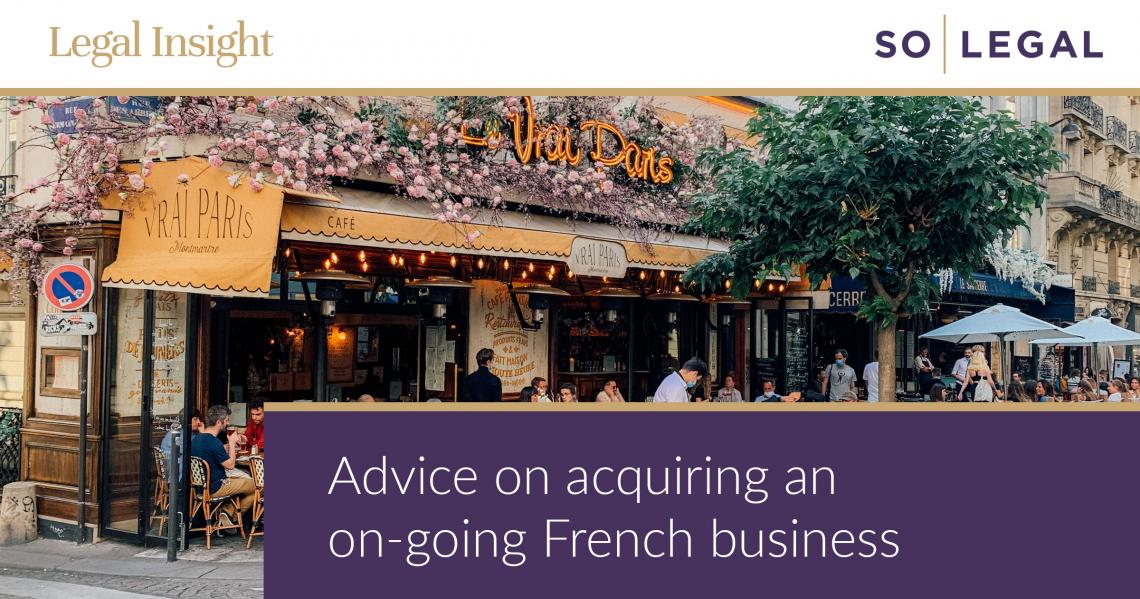
Advice on acquiring an on-going French business


20 Apr 2023
— Blog
This article will advise companies and entrepreneurs outside France who wish to acquire an on-going French business (fonds de commerce).
Important note: Citizen Avocats has produced this article as part of our collaboration. The contents do not constitute legal advice by SO Legal and are not intended as a substitute for legal advice.
Acquiring the assets, rather than the shares of a French company, can offer substantial benefits. Asset acquisition provides greater flexibility and lower liability. It is an advantageous method of acquiring small to medium-sized enterprises, as it allows the purchaser to negotiate which assets they are acquiring. Furthermore, one can avoid inheriting debts by acquiring assets instead of shares.
Citizen Avocats regularly helps foreign companies and entrepreneurs purchase French businesses and have compiled the following advice:
Internationality
It is important to remember that any transaction that could be considered international will involve several legal systems. It is therefore recommended that one considers which jurisdiction would be called upon to rule on potential disputes, which nation’s laws would apply to any contracts relating to an enterprise, and what language deeds and official documents should be drafted in.
Judges and jurisdictions
It may seem counter-intuitive to anticipate disputes, but it is undeniably a fact that disputes occur from time to time. With that in mind, establishing a dispute resolution process early in the purchasing process is essential.
No set rules dictate whom you should use to resolve disputes, courts in either your home country or France may be used, or you can even opt for private arbitration. The latter option is especially relevant when the amounts at stake are high, confidentiality is required, or the parties disagree with any of the state courts. It should be logical to align the applicable law, the competent jurisdiction and the administration, which will have a say after the sale. This avoids the risk of incompatibility, inconsistency, and excessive judicial costs (translation, legal opinions, etc.) should litigation arise.
Applicable laws
Prior determination of the applicable law is just as important. Firstly, substantial differences may exist between legal systems. This is particularly the case between French law (which is fairly regulated in the area of business transfers) and English law (which leaves plenty of room for contractual freedom). Specific clauses may prove indispensable or superfluous depending on whether one chooses one law or another. This can radically affect the course of negotiations.
It is advisable to agree upon a legal framework from the outset so as to avoid misunderstandings and negotiate as effectively as possible. For acquisitions from overseas, French courts have long accepted that traders may choose, by means of a special clause, the law applicable to their contract. Acquiring a French business will lead to several administrative and tax formalities (see below). Indeed, beyond the private relationship of the parties, it will be necessary to facilitate the fulfilment of these formalities. In general, we recommend sticking to the nationality of the target business. Thus, with some exceptions, an international acquisition of an on-going French business should be subject to French law.
Apart from very specific cases, it usually is best to keep things simple and work under the guidelines of one jurisdiction. To know which is best for you, we advise consulting your solicitor.
Language
In French law (as in common law), deeds are only valid if they express the full, complete and unvitiated consent of their signatories. How, then, can a document drafted in a language that some of its signatories do not speak validly express their consent? A recent case involving wills drafted in the incorrect language can be used as a prime example of why the question of what language(s) contracts are drafted in should not be ignored.
To best ensure that all parties fully understand their rights and obligations resulting from purchasing an on-going business, it is usually recommended that all contracts be drafted in French and English. It is then advised that you indicate which version shall prevail over the other in the event of any discrepancies, contradictions, imprecisions, or insufficiencies between said documents. This is the safest solution. It also avoids needing to produce certified translations before the administration or the courts or having the latter deform the parties’ intention by misunderstanding their contract.
Advice for negotiations
Business acquisitions are important transactions. They involve large sums of money and a transfer of ownership with many repercussions. This is why the negotiation phase is decisive and must be conducted according to the book. Below we have compiled some tips for the negotiation phase of an acquisition.
Sign a letter of intent.
For international transactions, we recommend signing a letter of intent. This document, which, with a few exceptions (e.g. confidentiality and exclusivity clauses), is not binding, provides a framework for the discussions. Without obliging the parties to make the deal, it helps reassure them of their serious intentions and outline the future contract’s main features.
This document is useful for several reasons:
- It can lock the negotiations into a time frame;
- It can determine which elements fall under the category of confidential information in order to restrict their circulation;
- It allows one to grant the potential buyer an exclusive right to negotiate;
- It can define the scope of due diligence; and
- It can significantly advance the negotiations by having the parties agree on the main features of the future deal.
Whether your letter of intent contains such clauses or not, it is crucial to ensure it does not bind you. That is why its wording should be chosen very carefully.
Negotiate in good faith.
Art. 1112 of the French Code civil leaves the initiative, conduct, and breaking off of the negotiations to the parties. However, this freedom, referred to as liberté contractuelle, has an imperative limit: bad faith. Right from the stage of negotiations, the parties must demonstrate their good faith (Art. 1104 and Art. 1112 of the same Code). For instance, engaging in pre-contractual negotiations without intent to conclude the contract is considered bad faith. Such is also the case when a party suddenly breaks off negotiations that were already quite advanced to the detriment of its counterpart.
The imperative of behaving in good faith is a matter of public policy. This bona fide principle, which is fully enshrined in French law, must be considered and respected right from the negotiation stage. Beyond French law, this principle underlies international trade in general.
Communicate all relevant information.
Art. 1112-1 of the French Code civil imposes yet another obligation of public policy: the party that possesses information directly related to either the contract’s content or the parties’ quality must communicate it. Foreign actors entering into commercial negotiations in France must keep this legal obligation in mind and be sure good lines of communication are maintained with all other parties involved in the acquisition of the business.
Advice on contracts
It is important to note that the legal and financial specificities of acquiring an on-going business in France differ from those in the UK. Below we give a broad outline of the contractual phase of acquisition.
The French (contractual and legal) framework
In France, it is pretty common for the definitive deed of sale to be preceded by a promise to sell (wherein the seller is legally bound to go on with the sale should the buyer exercise this option) and/or buy (wherein the buyer is legally bound to go on with the purchase should the seller exercise this option). This first deed could be an actual asset purchase agreement, but conditional on completing several events (conditions suspensives in French). If no condition precedents are necessary (e.g., there is no need to take out a bank loan), the sale can be recorded in a single deed which confirms the transfer of ownership by effect of the payment of the agreed price.
The deed of sale must define precisely what assets and elements of a business transfer ownership from the seller to the buyer. This is particularly necessary as tax authorities will need this information. Many other obligations can be enshrined in the deed, such as non-compete clauses or preservation of the business’s name or logo.
French law grants, by default, two legal warranties to purchasers for all sales, whether or not the parties have stipulated these warranties. Firstly, the seller must guarantee the buyer against partial and complete eviction (art. 1626 of the French Code civil). In practice, the seller can be held liable for behaviours troubling the “peaceful enjoyment” of the purchased business. Secondly, pursuant to Art. 1641 of the same Code, the seller is liable for any hidden defects in the thing sold when these defects render it unfit for its intended use or diminish the use that the buyer would not have acquired or would have given a lesser price if they had known about them.
These warranties are part of French law and, as such, cannot be waived or circumvented by either party. However, extending them beyond the standard protection provided by French law is possible.
What to be aware of when it comes time to purchase
If third parties are involved in purchasing an on-going French business, this could affect you. If the seller has creditors, for example, those creditors may pursue the buyer to settle the claims they have against the seller (typically, these fees would be deducted from the final payment paid to the seller). The period within which creditors can notify their opposition is ten days from the last of the compulsory advertising measures (see below).
In addition, under Art. 1684, 1. of the General Tax Code, the purchaser may be sued for payment of certain direct taxes owed by the seller up to the amount of the sale price of the French business. In principle, this tax solidarity lasts for a maximum of 5 months and a half (165 days) from the day of the sale to the extent that the purchaser can be challenged for a period of 90 days from the day on which the seller files a tax return for which he is responsible.
In practice, this double exposure of the buyer obliges the latter not to pay the sale price directly to the seller but rather to require that it be held in escrow (by one of the lawyers involved in the transaction) until the applicable time limits expire. All foreign buyers should be aware of this rule, as a direct payment to the seller does not protect them from these claims.
Formalities
Buying a business in France involves complying with certain tax and administrative formalities on which the effectiveness of the transaction depends. Most are incumbent upon the seller at their own expense and within certain time limits once the purchase act has been signed. Depending on the situation, these formalities may vary. By default, and in order of completion, they are as follows:
- The “tax registration” of the sale with the local service départemental de l’enregistrement. Following the signing, this must be done within 15 days (for private deeds). This registration gives rise to the payment, by the purchaser, of duties calculated by applying a rate to the sale price. They must therefore be anticipated in the acquisition plan;
- Publication in a medium authorized to receive legal announcements. This must also be accomplished within 15 days;
- Publication in the Bulletin Officiel des Annonces Civiles & Commerciales (BODACC) within three days following the previous publication.
Buying an on-going business in France is quite a regulated process. Being accompanied all the way through the operation will allow you to avoid putting it at risk by overlooking some of the imperatives involved.
Are you interested in acquiring a French business?
Citizen Avocats is a French law firm registered with the Bar of Bordeaux, which handles complex international cases. Their niche positioning allows them to meet the legal needs of a private clientele that demands rigour, responsiveness, and dedication. Their highly qualified team offers tailor-made services adapted to exceptional situations.
The firm’s expertise extends to the whole of France. In litigation, they plead before all Tribunals within the jurisdiction of the Bordeaux Court of Appeal.
The firm practices both in French and English.
Find out more about SO Legal’s exclusive collaboration with Citizen Avocats here.
Do you need advice
on French Law?